Infrared Imaging Services
Your Complete Source for Infrared Inspections and Thermal Imaging
Frequently Asked Questions
- What is Thermography?
- What does Emissivity mean?
- What type of equipment do we use?
- Where can Thermography be used?
- Where can I get Infrared training?
Answer – Thermography is the art and science of using infrared to observe and measure the temperature of an object’s surface. Infrared is not an “X-Ray” technology; it cannot “see” through objects. Only heat, radiating from the surface of an object, is visible to the infrared imager.
Infrared radiation occupies a small portion of the total electromagnetic spectrum. It is located at frequencies just below the lowest frequencies of the visible light portion of the spectrum, which is red, hence the name infrared or below red. Infrared wavelengths range from is .1um to 1000um.
Every physical object is made up of atoms and electrons which vibrate; the temperature of an object depends on how fast its electrons are vibrating. The faster they vibrate, the higher the energy levels and the warmer the object gets. As temperature increases, the wavelength decreases (Planks Law).
A surface can become hot enough such that the frequency of radiated energy increases to the point where it enters the visible light portion of the electromagnetic spectrum.(EM spectrum). At this point the energy can be observed without the need of a thermal imager. The first frequencies in the visible light spectrum are the reds; therefore we call the object “Red hot.”
As the surface continues to heat, its energy increases and the wavelength and spectrum width decreases, this effect is known as Plank’s law. As it becomes hotter the color temperature begins moving through the visible light spectrum. Starting with dark red, the color moves through orange, yellow, blue until all the color emissions are mixed together and they appear as white. At this point we say the item is “white hot”. As the heat increases, the peak emissions (Plank’s law) continue to shift upwards in frequency while the width of the emissions narrows. This reduces the red component as the peak moves more into the blue frequencies. To the human eye, this now appears as a bluish white light. At a still higher heat, the peak emissions move into the ultra violet region. EM spectrum.
An example of a very hot item giving off the bluish white light is the heat of an arc welder. The “light” of the arc is a whitish blue, a temperature hot enough to melt steel and emit EM radiation not only at the top end of the visible light spectrum, but also into the UV part of the spectrum.
Some other interesting facts about infrared is that some snakes have heat sensors placed between their eye and nostril on either side of their head which can locate infrared radiation in the 5 to 30um range. Not only does this enable them to see their prey in the dark, they can accurately strike at moving objects that are less then 0.2 °C (0.36 °F) warmer than the background! Animals such as caribou can see in UV, which helps them see the camouflaged white fur of a wolf against a snowy background. The wolf’s fur shows up as black in UV
Answer – The term “Emissivity”, also known as the “E” value is expressed as a percentage and is used to describe the efficiency of a surface for radiating electromagnetic energy at a given wavelength. Emissivity is expressed as a percentage from 0 to 1 where 0 would be no emission of infrared energy from the surface and 1 would be a perfectly efficient (Blackbody) ) radiating surface. In the real world however, nothing is perfect, so emissivity of an object will always be expressed as a number less than one such as .95 or .45.
If a surface cannot be a perfect emitter and emissivity is always equal to less than one, it begs the question, what happens to the remaining percentage? For example, if the emissivity of a surface is .75, then what is the remaining .25 made of? The answer is that the compliment to emissivity is called “Reflectivity”. Emissivity and reflectivity are two sides of the same coin; you cannot have one without the other. All surfaces have both an emissive component and a reflective component, simultaneously.
The higher the reflectivity number is the more “shiny” the object appears in both visible light and infrared. A surface, which has an “E” value of .5, is also .5 reflective. This means that 50% of the energy seen by the infrared imager may be coming from another source being reflected off of the target surface. The reflected energy may be from a source colder than the target’s surface or hotter than the target’s surface. Unfortunately, the infrared imager cannot tell the difference between reflected and emitted energy. That determination is left to the trained thermographer to understand and properly set the emissivity and reflectivity controls in the infrared imager, in order to be able to accurately measure temperatures.
Wood, concrete, dirt, water, brick, human skin, most organic materials tend to have relativity high emissivity values and are typically good emitters and absorbers (Kirchhoff) of infrared radiation. These materials can easily be viewed through an infrared imager and measured with accurate results by adjusting the imager’s emissivity value to match the “E” value of the object’s surface and properly setting the other compensating controls in the imager’s settings.
Low emissivity surfaces such as polished steel, shiny copper, aluminum foil, and in general metals with various degrees of light oxidation do not emit infrared very well. With these materials, the infrared imager will “see” relatively little of the object’s heat and much more of what the shiny surface is reflecting from the background of the room it is in. Low emissivity surfaces are more prone to measurement and observational errors because they do not radiate infrared well.
Surface emissivity and reflectivity are a function of the microtexture of a surface relative to the incident wavelength. When the texture becomes so fine that the wavelengths can no longer fit into the texture, it is reflected away from the surface. In addition, because of the mismatch between wavelength size and surface texture size, the surface cannot emit infrared energy. Simply put, reflective surfaces are bad antennae for broadcasting and receiving electromagnetic energy at IR frequencies.
When the EM wavelengths are able to fit into the surface micro texture, not only can the infrared energy be absorbed,(Kirchhoff) but it can also be broadcasted or emitted. Surfaces with high emissivity values are very good at broadcasting and receiving electromagnetic energy at IR frequencies.
We use the P640 High Definition infrared camera from FLIR, the largest infrared camera manufacturer in the world!
The P640 infrared camera/thermal imager sets a new standard for professional thermography with its high-definition 640 X 480 infrared detector, delivering exceptional resolution and image quality for accurate infrared surveys. Due to its high pixel count, accurate readings can be taken on smaller objects at further distances due to its smaller IFOV angle, or pixel footprint size, also known as the “Spot size “. The smaller the spot size, the more pixels the imager will have across any target at a given distance. This enables the imager to make more accurate measurements, from a further distance and adds visual detail to the thermogram.
High Definition is what gives Infrared Imaging Services some of the clearest and most informative Infrared images available in the industry today. With 307,000 individual temperature measurement pixels, that’s 4 times the pixel resolution of conventional Infrared cameras!
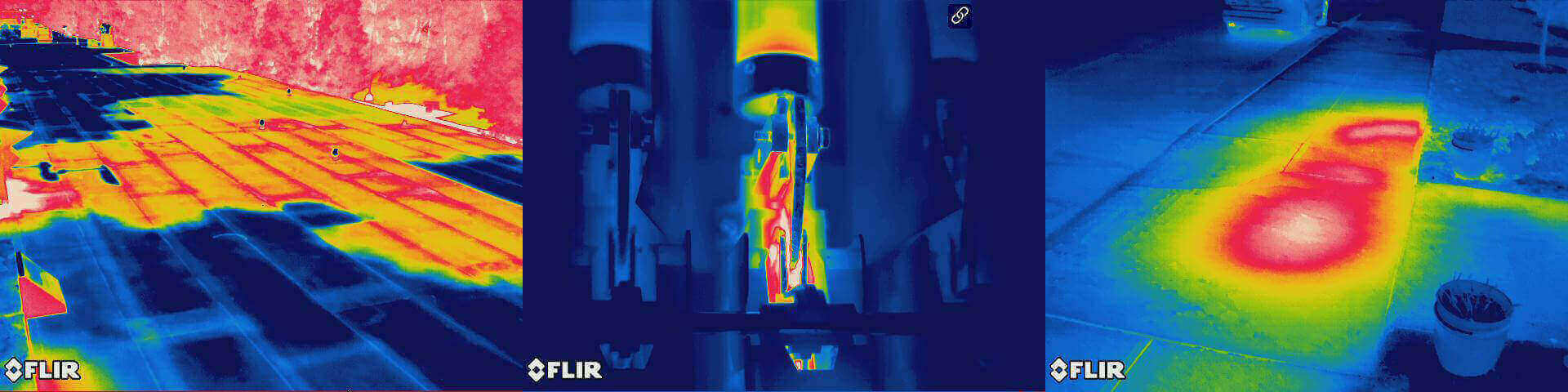
Take a close look at the beautiful images in this website and see the photographic quality of the infrared thermograms produced by this imager. Note how this imager and its lenses combine to produce clear, detailed and useful thermograms, making it easier to read the reports, understand the problems and know what to repair!
In the first question, “What is Thermography?”, we discussed that everything above the temperature of absolute zero gives off some amount of heat. So if that is true, and it is, then the applications for Infrared analysis are virtually endless!
Commercial property management and manufacturing companies conduct infrared electrical inspections of their buildings and systems to safely detect overloaded and loose or corroded electrical distribution equipment. Infrared is used to locate wet insulation in roofs, fluid levels in tanks, clogged pipes and broken valves. It can find broken steam pipes below ground and leaking radiant heating pipes.
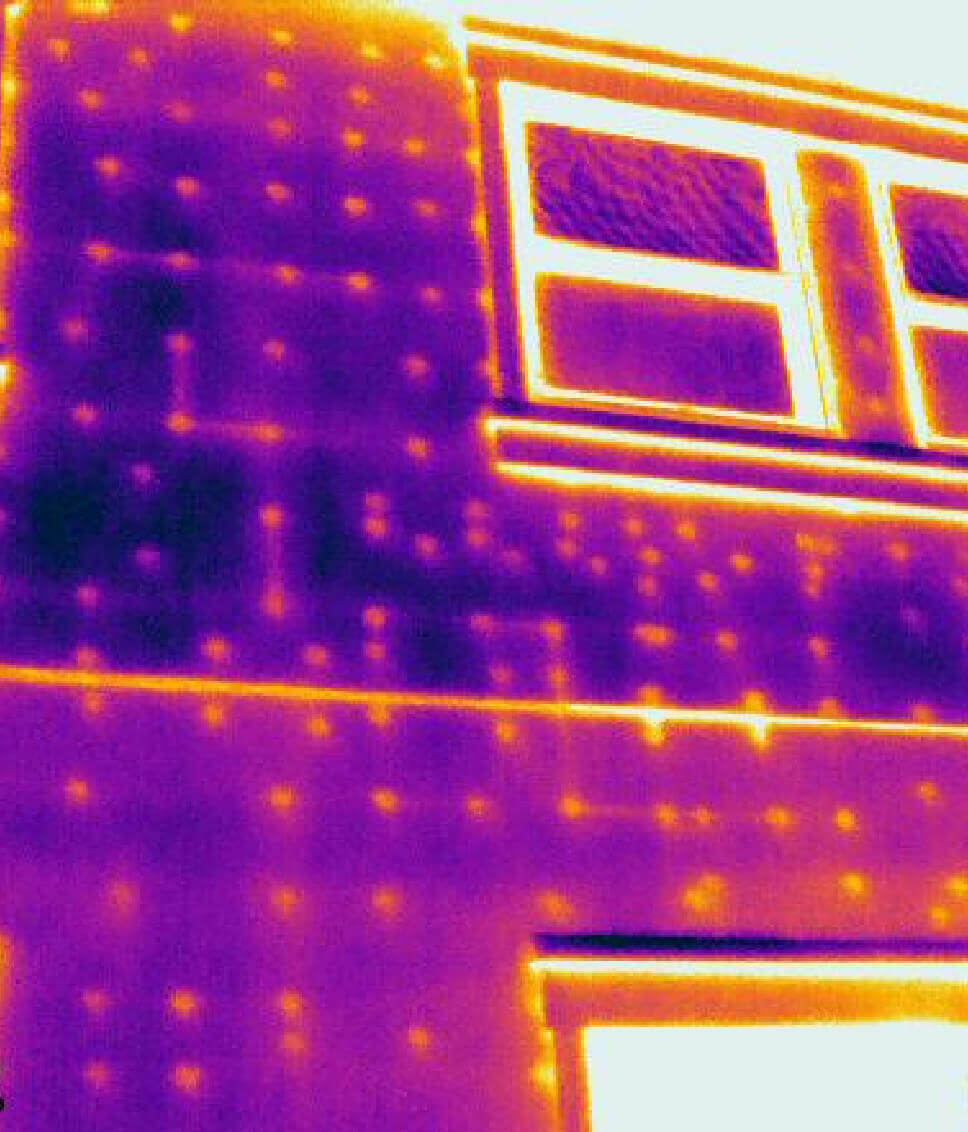
Missing insulation, air leaks and other building energy problems can be diagnosed by using infrared inspection. Infrared is perfect for locating high friction points of worn belts and mechanical bearings, electrical motor inspection, process equipment such as heaters and furnaces, air conditioning, steam, printed circuit board evaluation, pollution tracking, forest fire mapping, military, surveillance and many more applications.
Because “Everything gives off heat”, you may now have an idea of how Infrared technology could work for you. If so, just give us a call and we’d be glad to discuss your application. Contact us today to ensure you are taking advantage of all the benefits Infrared technology has to offer your company.
Infrared Imaging Services 845-641-5482
Answer – There are several organizations which provide infrared training. We have worked with and recommend the Infraspection Institute for certification training.
Since 1980, Infraspection Institute has provided infrared training, infrared certification, and support services for thousands of thermographers worldwide.
Infraspection also publish software, Standards, and technical articles for Thermographers and NDT professionals.
Infraspection Institute’s services are provided without marketing hype since they do not manufacture or sell infrared equipment. Staffed by highly experienced, Certified Infrared Thermographers, they provide Real World Solutions for today’s challenges.
Infrared Imaging Services
Infrared Imaging Services is a division of Jersey Infrared Consultants and a member in good standing of the United Infrared Network. As a member, we receive support for our customers from industry experts with decades of combined experience. We are certified for BlockwallScanIR™, EnergyScanIR™ RoofScanIR™. ElectricIR™, and DataCentIR™. Call or use the Contact us page to discuss your commercial thermal imaging needs. We provide infrared electrical inspections as requested by your insurance company. We are Level III thermographers certified by the Infraspection Institute.